The Future is Integrated: How Smart Farms Are Building Wealth and Resilience in Nigeria
The Future is Integrated: How Smart Farms Are Building Wealth and Resilience in Nigeria
By Adeboye Prince Adetu
For FarmersHub.com.ng
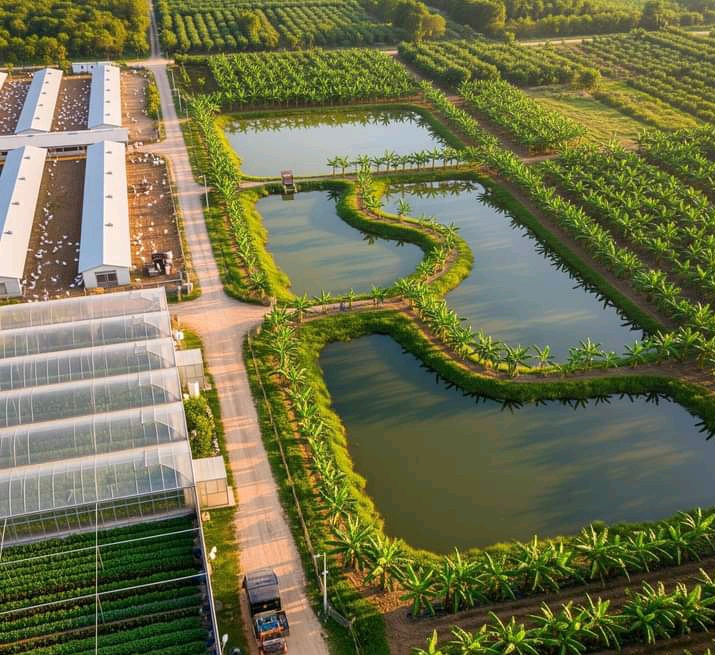
For generations, Nigerian farmers have wrestled with the same harsh realities: unpredictable rains, rising input costs, volatile markets, and the back-breaking risk of relying on a single crop. What if there was a way to turn these challenges into a symphony of productivity, where every output finds a purpose and every input works multiple times? Welcome to the era of Integrated Farming Systems (IFS)—where aquaculture, greenhouse technology, and diversified cropping don’t just coexist, but actively fuel one another in a closed-loop cycle of profit and sustainability.
This isn’t just another farming method; it’s a fundamental redesign of the agricultural enterprise. It’s about building a farm that functions like a natural ecosystem—efficient, resilient, and abundantly productive.
The Core Principle: Waste is Just a Resource in the Wrong Place
The genius of integrated farming lies in its circular logic. Fish waste becomes fertilizer for crops. Crop residues and by-products become feed supplements for fish. Water is recycled from ponds to irrigated beds and back. The output of one enterprise is the precious input for another.
The Result? Farmers report 30–50% reductions in fertilizer and feed costs, while creating multiple, staggered income streams from the same piece of land. You’re not just saving money; you’re building a business with several pillars, so if one market dips, others hold your income steady.
Breaking Down the Integrated System
1. The Aquaculture Engine: More Than Just Fish
Your pond is the heartbeat of the integrated farm.Beyond producing catfish, tilapia, or ornamental fish generating ₦1.2M – ₦4M+ annually per well-managed pond, it serves as a living reservoir of nutrient-rich water.
· Function: Fish provide protein and income. Their ammonia-rich water, once filtered naturally or through simple systems, becomes liquid gold for vegetables.
· Multiplier Effect: Use pond water to irrigate your greenhouse or open fields. Grow aquatic vegetables like water spinach on the surface. You’ve turned water, feed, and waste into three sources of revenue.
2. The Greenhouse: Your 365-Day Profit Center
While open-field farmers wait for the rains,your greenhouse provides year-round, climate-controlled production. This translates to harvesting premium tomatoes, cucumbers, or peppers during off-seasons when market prices can be 2–3 times higher.
· The Advantage: You control the environment. Reduced pest pressure means less spending on chemicals. Consistent, high-quality harvests attract and retain reliable buyers—supermarkets, hotels, exporters—who pay for reliability.
3. Strategic Diversification: Your Financial Safety Net
Surround your pond and greenhouse with diverse open-field crops:vegetables, maize, legumes, fruits, and herbs. Use the fertigated water from the ponds.
· Why It Works: Staggered planting leads to continuous harvests and cash flow. Legumes fix nitrogen in the soil for other crops. This diversity spreads your biological and market risk. It’s financial resilience built right into your farm’s design.
The Pillars of Success: Water, Infrastructure, and Mindset
· Water Security = Income Security: Your ponds harvest and store rainwater. In times of drought, while neighbours struggle, your integrated farm thrives. You have a buffer. Efficient water recycling means you use every drop multiple times.
· Infrastructure is an Investment, Not a Cost: A good internal road network reduces post-harvest losses, allows buyers to access your produce, and cuts your labour costs. It presents a professional image that commands better prices. Good infrastructure doesn’t cost money; it makes money.
· The Economic Reality: Yes, the initial investment for ponds, greenhouses, and piping is significant. However, the Return on Investment (ROI) typically comes within 2–4 years. After that, integrated systems are documented to generate 3–5 times more net income per acre than conventional single-crop farming. This is wealth-building infrastructure.
Beyond Profit: The Environmental Dividend
Integrated farming is a steward of the land. It leads to:
· Minimal chemical runoff and pollution.
· Near-zero waste through resource recycling.
· Healthier, more biologically active soils from constant organic matter addition.
· Improved biodiversity on the farm.
You are building a legacy of fertility for future generations.
Start Small, Scale Smart
You don’t need 100 acres to begin. The integration principle works at any scale.
· Phase 1: Start with one fish pond and a small, connected vegetable plot.
· Phase 2: Reinvest profits into a modest greenhouse or expand pond capacity.
· Phase 3: Add more components—poultry, beekeeping, mushrooms—as your mastery and market grows.
The secret is not the size, but the synergy.
The Bottom Line for the Nigerian Farmer
Traditional farming gambles with weather and global commodity prices. Integrated farming takes back control. It controls costs by recycling resources. It controls income by diversifying outputs. It controls risk by building biological and financial resilience.
The message is clear: Stop farming harder. Start farming smarter.
Integration is not just a technique; it is the key to a profitable, sustainable, and secure agricultural future for Nigeria. It’s time to build your integrated empire, one symbiotic relationship at a time. 🔑
Are you ready to integrate? Share your thoughts or questions in the comments below or visit our forum on FarmersHub.com.ng to connect with other integrated farming pioneers!
Adeboye Prince Adetu is an advocate for sustainable agricultural systems and a contributor to FarmersHub.com.ng, Nigeria’s premier online community for the modern farmer.
Comments (0)
Loading comments...